
Salah A. Selim *; Moustafa R. K. Ali ;Ibrahim M. Ibrahim : Hala R. Ali; Haithem A. M. Farghali ; Ahmed H. Osman ; Yousef Adel ; Mostafa A. El-Sayed
Association of Egyptian-American Scholars
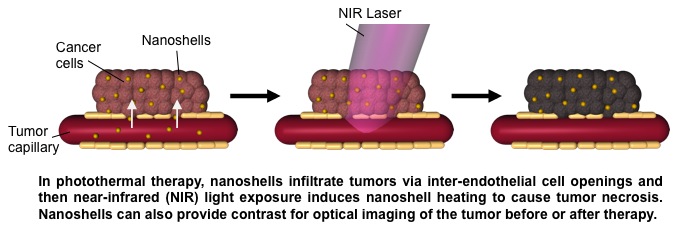
Plasmonic photothermal therapy (PPTT) is a cancer therapy in which gold nanorods are injected at the site of a tumor before near-infrared light is transiently applied to the tumor causing localized cell death. Previously PPTT studies have been carried out on xenograft mice models. Herein we report a study showing the feasibility of PPTT as applied to natural tumors in the mammary glands of dogs and cats, which more realistically represent their human equivalents at the molecular level. For the experimental design, we divided the animals into 4 different groups. 30 cases were all diagnosed with adenocarcinoma and the animals were monitored for 1-2 years after treatments. Group (I): 3 cases (2 dogs and 1 cat) were treated only by mastectomy (surgery) (control group) and all of them died within a few weeks. Group (II): 5 cases (all dogs) were treated with mastectomy first. Then each tumor wound was divided into two halves and only one half was exposed to PPTT. After treatment, 2 cases in this group were completely cured. In the other 3 cases, the half wound that was not exposed to PPTT had tumor ruptured and regrown, causing animal death within 1 year. In Group (III) 10 cases (7 dogs and 3 cats), we optimized a regime of three low PPTT doses at 2-week intervals that ablated tumors mainly via apoptosis. Group (IV): 12 cases (6 cats and 6 dogs) were treated with surgery followed by whole wound treatment by PPTT. This regime showed complete remission without any recurrence for 8 case, however 4 cases (2 dogs and 2 cats) died 4-12 months after therapy for other reasons such as pneumonia (no tumor found, based on X-ray). Histopathology, X-ray, blood profiles, and comprehensive examinations were used for both the diagnosis and the evaluation of tumor statues before and after treatment. Histopathology results showed an obvious reduction in the cancer grade shortly after the first treatment and a complete regression after the third treatment. Blood tests showed no obvious change in liver and kidney functions. Similarly, X-ray diffraction showed no metastasis after 1 year of treatment. In conclusion, our study suggests the feasibility of applying the gold nanorods- PPTT on natural tumors in dogs and cats without any relapse or toxicity effects after 1 year of treatment.
This article was published in 3alamaltanmya
sponsored by Future Builders International Academy
Led by Dr.Maha Fouad

